Commercial Waste in Bishops Stortford

Commercial waste in Bishops Stortford needs a straightforward service that can deal with day-to-day business rubbish, bulky mixed loads and routine collections without making the process more complicated than it needs to be. We handle commercial waste removal for premises that produce regular operational waste, clearances and one-off loads, with an approach that keeps the work organised from the first enquiry through to collection. If your business needs a practical way to move waste out of the way, the service is arranged to support that outcome.
Our work covers a range of common commercial waste streams, including office furniture, general business rubbish, small-scale clearance loads and items that are awkward to store while you wait for a collection. We also handle related services such as business waste removal, office clearance and waste removal, so customers can match the job to the right kind of support rather than forcing everything into a single generic service. Clearer sorting at the start usually helps make the collection itself more efficient.
To request a quotation, it helps to describe the type of waste, the amount involved and whether there are any access limits or lifting concerns. You do not need to overcomplicate it; a brief outline is often enough to begin. If the load includes mixed materials, separation into obvious groups can make pricing and collection planning easier to understand. When you are ready, send the details through and ask for a quote that reflects the actual job.
Commercial collections for offices and workplaces
Office and workplace waste often needs more than a simple bin emptying arrangement, especially when desks, chairs, filing units or boxed materials start to build up. Our commercial waste collections are suited to businesses that want a direct way to remove items from work areas, storage rooms or reception spaces. The service can support clear-outs linked to refurbishments, moves or general operational tidying, with attention paid to the type of waste and the access needed to remove it safely.
Where the waste is mostly office-based, the most efficient collection usually depends on how much is reusable, recyclable or simply ready for disposal. Furniture, monitors, printers and mixed office clutter may need different handling within the same job. We can also support related needs through furniture clearance, furniture disposal and confidential shredding, giving businesses a practical route for items that are not suitable for ordinary bin removal.
The best commercial collections are planned around what is actually on site, not around assumptions. If you are comparing options, it can help to think in terms of what must go, what can stay and what needs special handling. That keeps the quotation process focused and helps the collection day run more smoothly. For larger office projects, a clear list of items and any access notes usually supports a more accurate response.
Clearance services for business premises

Some commercial waste jobs are really clearance jobs in disguise: a stockroom, unit or workspace has gathered items that are no longer needed, and the task is to remove them without disrupting the business any longer than necessary. Our clearance services are useful where the job includes mixed contents, not only bagged waste. That may include shelving, loose items, redundant furniture and general clutter that has been taking up usable space.
We also support more specific property types through flat clearance, home clearance, house clearance and garage clearance. While those pages focus on different settings, the same practical principle applies to many commercial jobs: sort the load by what needs removal, identify anything that may need special handling and keep the collection plan as clear as possible. The aim is to make the waste leave the site in a way that fits the premises and the business routine.
For customers seeking a quotation, it is useful to note whether the task is a single area clearance or a wider multi-room job. A stockroom full of mixed items is different from a straightforward waste pickup, and the most accurate estimate normally depends on the amount, access and disposal requirements. If you are unsure how to describe the work, start with the room, the contents and the approximate size of the load.
How commercial waste is handled
Sorting, loading and disposal
Commercial waste work works best when the collection process is organised around the actual contents of the load. That may mean separating reusable items from broken furniture, grouping recyclable materials and identifying anything that needs separate disposal. For many business customers, the real value of the service is not only the removal itself but the fact that the waste is taken away in a way that feels orderly and manageable. Good handling reduces guesswork for the customer and helps keep the job under control on site.
Not every item can be treated in the same way. Appliances, upholstered furniture, IT equipment and mixed materials may all call for different decisions before they are loaded and removed. Where relevant, customers may also need support with fridge and appliance removal, mattress and sofa disposal or builders waste clearance. Those services are useful when the load contains items that are bulky, awkward or not suitable for standard disposal routes.
A sensible quotation request normally includes a simple description of the contents and a note about any items that are especially heavy, fragile or awkward to move. If you only have an approximate idea, that is still a useful starting point. You can keep the description brief and still cover the essentials: what is being removed, how much there is and whether access is easy or restricted.
Office furniture and fit-out waste

Office clearances often produce a specific mix of waste: desks, chairs, storage units, partitions, old fittings and general clutter from cupboards or meeting rooms. Our service can deal with that kind of fit-out or de-fit load where the aim is to clear the premises in a sensible sequence. This is especially useful when a workspace is changing use, being reorganised or making room for new equipment.
Furniture and fit-out waste may be too bulky for routine bins, but it does not need to become a storage problem while you wait for a separate solution. The right collection plan depends on the quantity involved, how the items are positioned and whether they need dismantling before removal. In some cases, related services such as loft clearance and garage clearance are helpful references for the sort of mixed-item clear-out that can occur when workspaces, storage rooms or side areas are being emptied.
If your business is preparing for renovation, it is usually best to separate the items that will be reused from those that are only occupying space. That makes it easier to describe the job and helps avoid overcomplicating the quote. A clear inventory is useful, but so is a short explanation of the site conditions. Access, loading distance and item size can all affect how the work is approached.
Waste types and service choices
Businesses often need different service choices depending on what they are trying to clear. A storage area with office chairs calls for a different approach from a unit containing mixed rubble, packaging and redundant fittings. Our commercial waste service is designed to handle that variety in a practical way, so customers are not forced to separate every item into a different process before getting started. The aim is to match the removal method to the actual waste on site.
For more specialised loads, related pages can help you choose the most relevant option. For example, garden clearance can suit outdoor maintenance waste, hazardous waste disposal is the clearer route for materials that need extra care, and recycling and sustainability explains how broader waste decisions may be considered. These are useful when a job contains more than one material type and the customer wants to understand the likely route for each part of the load.
Good service choice depends on the waste itself, not just on the size of the pile. A small load of sensitive waste can require more care than a larger pile of general rubbish, while a bulky but simple collection may be relatively straightforward. That is why the quotation stage should focus on content, access and disposal needs rather than broad labels alone.
Commercial waste for refurbishments and property changes
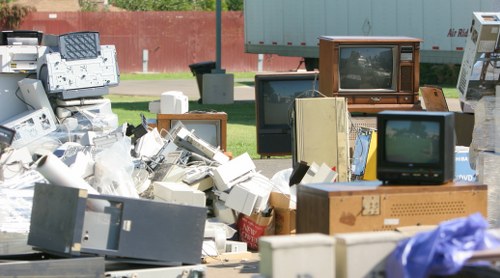
Refurbishment and property-change projects often create a combination of waste types at once: broken fixtures, old furniture, packaging, redundant fittings and general site clutter. Our commercial waste service is suitable for these mixed loads when the objective is to clear the area and keep the project moving. The service can be adapted to one room, one floor or a wider business premises, depending on what needs removing and how the site is arranged.
When commercial waste is linked to a change of use, the work often benefits from early planning. Knowing whether items are being dismantled, whether there are narrow access points and whether anything is likely to be awkward or heavy helps shape the collection. If the job involves materials with safety considerations, it may also be useful to compare them with health and safety policy and insurance and safety, which can support a clearer understanding of the company’s general approach to safe working.
Two things usually make a quotation easier to assess: the amount of waste and the type of waste. If you can describe both, the response is likely to be more practical. Where a site has already been partly cleared, mention that too, because a partially emptied room can change the time and lifting involved. For many commercial customers, that short note is enough to turn a rough idea into a useful quote request.
About Bishops Stortford
Bishops Stortford is a market town in Hertfordshire, close to the county boundary with Essex and positioned on the River Stort. Its historic core developed around the crossing and market functions that shaped many older English towns, and the High Street still reflects that layered past through a mix of older buildings, shops and civic uses. The town’s name is commonly associated with its ecclesiastical history, and the settlement grew around the bishop’s manor in the medieval period. Over time, Bishops Stortford expanded beyond the centre into residential districts and employment areas, while retaining a recognisable town core with local shopping and services. Rail connections to London and Cambridge have long contributed to its role as a commuter town, but the centre still carries the character of a regional market place rather than a purely suburban district. The River Stort and nearby green spaces provide a softer edge to the built environment, and the town’s setting makes it feel closely connected both to open countryside and to larger transport routes. Churches, schools and older public buildings sit alongside more modern development, giving the area a varied townscape. That combination of medieval origins, later expansion and present-day commercial activity gives Bishops Stortford a distinct identity within Hertfordshire, with a centre that remains active while the surrounding areas continue to evolve.
Business waste for shops, units and small sites
Retail units, small workshops and shared business premises often produce waste in uneven bursts rather than at a fixed rhythm. That can include packaging, display items, broken furniture, redundant stock storage and mixed rubbish that has no easy home in standard bins. Our commercial waste service is suitable for these jobs because it can handle practical removal without requiring the customer to create a complicated internal waste plan first. The focus is on getting the unwanted material away efficiently and sensibly.
Where a business site produces both everyday rubbish and one-off clearance waste, it can help to separate the regular collection needs from the occasional load. The commercial job is then easier to describe and the quotation can reflect the right kind of work. For customers who need to compare wider waste options, pricing and quotes is a useful place to start, especially when the question is how different volumes or item types may affect the overall estimate.
For many small sites, the practical question is not whether waste exists, but how best to remove it without interrupting trade. That is why it helps to mention customer access, loading points and any items that require two people rather than one. A few well-chosen details can make a big difference to the accuracy of the quote and the smoothness of the collection.
Items, limits and useful preparation

Some commercial waste items are more straightforward than others. Loose rubbish, packaging, worn furniture and ordinary office contents are generally easy to describe, while awkward, heavy or sensitive items need more careful identification. Our service is best used when the customer wants a clear route for removing the waste and is able to note anything that might affect loading, disposal or handling. That includes items that are damaged, oversized or mixed with material that should not be treated as general waste.
A few practical points are usually enough before a quotation is prepared.
- What type of waste needs removing
- How much there is, roughly
- Whether access is simple or restricted
- Whether anything is especially heavy, fragile or confidential
If you need a quotation for commercial waste in Bishops Stortford, send the details of the load and ask for the most suitable option. You can also say if the job is part of a larger clearance, a move or a refurbishment, because that context may help shape the estimate. For a direct next step, make your enquiry now and request a quote for the work you need.